You've never really been an anxious person. Now your heart races for no reason, a sense of dread settles in before you've even got out of bed, and things you used to breeze through suddenly feel like too much.
If that sounds familiar, you're not imagining it and you're not losing your grip. Anxiety is one of the most common parts of perimenopause and menopause, and one of the least talked about. There are real reasons it happens, and real things that can help.
Can menopause cause anxiety?
Yes. A large US study followed nearly 3,000 women through midlife for ten years. Women who hadn't been anxious before were more likely to report high anxiety during perimenopause and after menopause than they had been beforehand. That was true even after the researchers took account of stressful life events, money worries and hot flushes (Bromberger and others, 2013).
So if anxiety has turned up in your forties or fifties, often alongside changes to your periods, the menopause transition is a very reasonable suspect.
What does menopause anxiety feel like?
It shows up differently for everyone, but common experiences include:
- a racing or pounding heart that comes out of nowhere
- a constant low hum of worry, or sudden waves of dread
- "what if" thoughts that go round and round
- feeling on edge, irritable or easily overwhelmed
- losing confidence in things you've done for years, like driving or speaking up at work
- a churning stomach, tight chest or shallow breathing
- panic attacks, sometimes for the first time in your life
Many women say the hardest part is that it doesn't feel like "them". That sense of not recognising yourself can be frightening in its own right.
Why does perimenopause cause anxiety?
There usually isn't one single cause. It's more often several things stacking up at once.
Swinging hormones. In perimenopause, oestrogen and progesterone don't fall in a neat, steady line. They rise and dip unpredictably, sometimes from one month to the next. Both hormones act on the brain, including the systems involved in mood and your response to stress. When they swing, your usual emotional buffer can feel much thinner.
Hot flushes and palpitations. A hot flush can bring a pounding heart, sweating and a rush of alarm, which feel almost exactly like anxiety. Women's Health Concern, the patient arm of the British Menopause Society, notes that palpitations can happen quite normally with hot flushes. It also points out that being anxious and stressed can make flushes harder to deal with. The two can feed each other.
Broken sleep. When you're running on too little sleep, everything feels bigger and harder to cope with.
Midlife itself. This stage of life often brings ageing parents, teenagers, children leaving home (or not), and work pressure, all at the same time. Hormones don't create those pressures, but they can make them much harder to carry.
Why is my anxiety worse at night?
Lots of women find their anxiety peaks in the evening or in the small hours. There are a few reasons for this.
At night there's nothing to distract you, so worries get your full attention. You're tired, which makes it harder to put things in perspective. And night sweats can jolt you awake with a racing heart, which your brain can easily read as danger.
Then there's worry about sleep itself. Women's Health Concern explains that worrying at night about being awake, and about how you'll cope tomorrow, can lead to anxiety that makes sleep even less likely. A useful phrase to try is: "I'll deal with this tomorrow when I can think clearly."
How long does perimenopause anxiety last?
There's no fixed timeline, and it's honest to say so. For some women it settles once hormones level out. For others it lingers after periods have stopped; in the study above, the higher risk continued after menopause for women who hadn't been anxious before.
That's why it's worth getting support now, rather than gritting your teeth and waiting for it to pass.
What can help with menopause anxiety?
CBT (cognitive behavioural therapy)
CBT is a practical talking therapy that looks at the links between your body, your thoughts, your feelings and what you do. Women's Health Concern describes it as helpful for anxiety and stress, low mood, hot flushes, night sweats and sleep problems. In 2024, NICE's menopause guideline (NG23) was updated to include menopause-specific CBT as an option for hot flushes, sleep problems and low mood linked to menopause.
A few CBT ideas you can try today:
- Remember that anxious thoughts are not facts. They're one view of a situation.
- Ask yourself: Is there really a threat here? What would I say to a close friend who felt like this? Have I coped with something like this before?
- Notice what you do when you're anxious. Overworking, overeating or avoiding people tends to keep anxiety going. Try a small, kinder alternative instead.
- Do more of what calms you, even for a few minutes a day: a walk, a call with a friend, a book.
In England, you can refer yourself to NHS Talking Therapies for anxiety without seeing a GP first.
Slow, steady breathing
When you're anxious, breathing gets fast and shallow. Slowing it down is one of the quickest ways to tell your body it's safe. Women's Health Concern suggests breathing slowly from your stomach. Put one hand on your chest and one on your stomach. The hand on your chest should stay fairly still while the hand on your stomach rises and falls. Practise when you're calm, so it's easier to reach for when you're not.
Look after the basics
- Move every day, even a brisk walk. It burns off some of that stress energy.
- Go easy on caffeine and alcohol. Both can make a jittery body more jittery, and alcohol often wakes you in the night.
- Talk about it. Friends going through the same thing can be a real comfort.
What can I take for menopause anxiety?
This is one of the most searched questions, and the honest answer is: talk to your GP before you take anything.
| Option | What to know |
|---|---|
| HRT | NICE says doctors should consider HRT for low mood that starts around the same time as other menopause symptoms. Your GP can talk you through whether it suits you. |
| Antidepressants | The NHS says you may be offered these for low mood, depression or anxiety caused by menopause. |
| CBT | Can be used on its own or alongside medicine. |
| Herbal remedies | The NHS says there's very little evidence on how well they work or how safe they are. Some, such as St John's wort, can interact with other medicines. |
If you already take any medicine, please don't stop or change it without talking to your GP or pharmacist first.
When to see your GP
Book an appointment if:
- anxiety is getting in the way of work, relationships or daily life
- you're having panic attacks
- you've had palpitations that keep coming back or last more than a few minutes
Call 999 or go to A&E if palpitations come with chest pain, shortness of breath or feeling faint.
If you ever feel you can't cope or have thoughts of harming yourself, please get help straight away. Call 111, contact your GP urgently, or call Samaritans free on 116 123, day or night.
Where relaxation and hypnosis recordings fit in
Alongside the steps above, some women like to set aside a quiet twenty minutes in the day for a relaxation or hypnosis recording. It's a chance to stop, breathe and let your body settle.
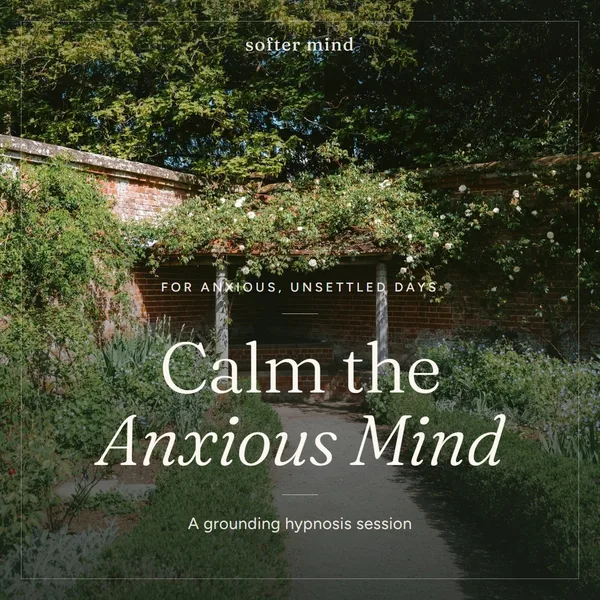
Our recording Calm the Anxious Mind is a guided relaxation with slow breathing and a simple cue you can practise and use any time: feet flat on the floor, a hand on your stomach, a long breath out, and the word "settle". It's a relaxation recording, not a medical treatment, and it doesn't replace advice from your GP.
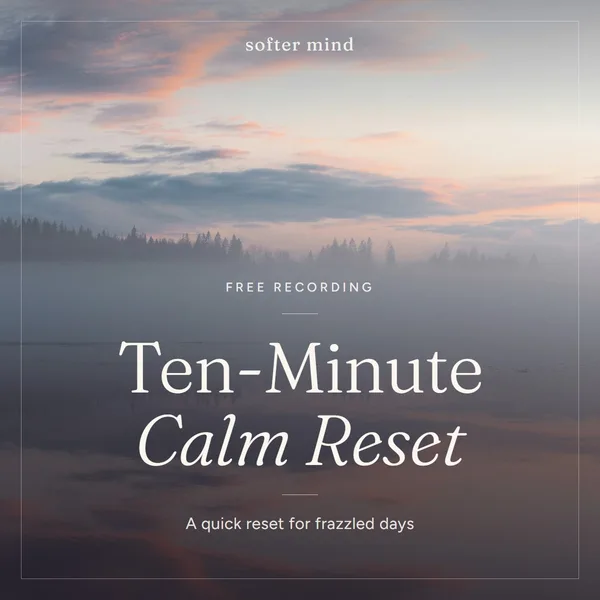
If you'd like to see whether this kind of recording suits you, you can listen to our free Ten-Minute Calm Reset first.
This article is general information, not medical advice. If you're worried about any symptom, please talk to your GP or pharmacist.